





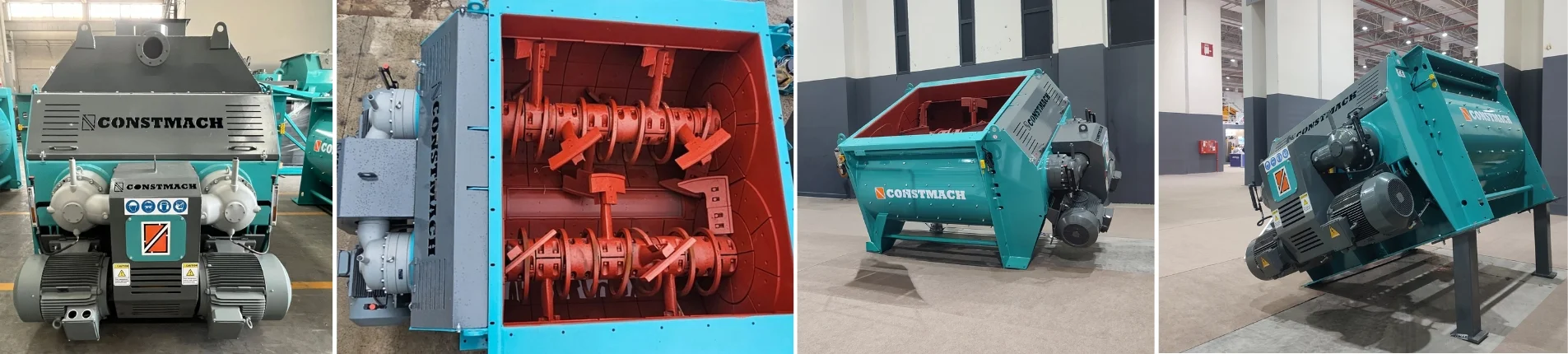

The CTS-3 Twin Shaft Mixer is where the CTS range crosses into high-volume production, and selecting it means confirming that a 3 m³ compacted batch and twin 55 kW drives suit the plant's hourly targets and the products being cast. The notes below address what buyers weigh beyond the specification table.
Where It Is Used
- High-capacity central ready-mix plants supplying large urban and infrastructure projects
- Busy precast factories casting beams, panels, pipes and segments on parallel lines
- Paver, kerbstone and block plants operating at high daily volume
- Operations supplying tunnel, metro, port and large building projects with steady high demand
- Plants that need genuine high throughput without the largest central-mix frames
What It Produces
Each cycle delivers 3,000 lt (3 m³) of compacted concrete from a 4,500 lt charge. The mixer handles structural ready-mix, high-strength concrete and stiff precast mixes, and the intensive counter-rotating action distributes cement, admixtures, pigment and fibre thoroughly even in dense, low-water batches. The 3 m³ size fills standard transit mixers efficiently and keeps high-rate precast lines supplied.
Installation And Power
The two 55 kW motors give a total mixer drive of 110 kW, so plant switchgear, cabling and any standby generator must be sized accordingly along with the rest of the plant. The mixer requires a hydraulic supply for the discharge door and an electrical feed for the automatic lubrication pump. Its mass and footprint call for a fixed, well-founded plant structure rather than a mobile chassis.
Maintenance And Wear Parts
- Side body wearing plates: 20 mm Hardox, thicker than the CTS-2 for longer life under higher flow
- Main body wearing plates: 20 mm
- Mixing arm wearing plates: 30 mm, the primary wear items, inspected most often on a high-duty unit
- Four shaft bearings and seals served by the automatic lubrication system; keep the reservoir filled and confirm delivery to every point
- Monitor arm and paddle clearance to the liners and adjust as they wear, since worn clearance lengthens mixing time
- Thorough end-of-shift washout is essential to prevent hardened build-up at this throughput
Comparison Versus Adjacent CTS Models
Against the CTS-2, the CTS-3 adds 50 percent more batch volume (3 m³ versus 2 m³), raises drive power to two 55 kW motors, and uses thicker 20 mm Hardox side liners for longer wear life under heavier flow. Below it, the CTS-1 and CTS-2 serve compact and mid-range plants; above it, the CTS-4 (4 m³, two 75 kW) and CTS-5 (5 m³, two 90 kW) are aimed at central-mix plants, RCC and dam work, and the largest precast operations. The CTS-3 is the right choice when the plant needs sustained high output but the project volumes do not justify the largest central-mix frames.